

BY: Sam Koppelman, Matthew Termine, JD Jean-Jacques
EDITOR: Vikas Kumar
Guggenheim is private, but one of its funds is not. For eight years, GOF has paid shareholders a distribution far above what its portfolio has earned. How? By selling billions of dollars of new shares at a premium to NAV. Now, the premium that powered the machine has collapsed to a discount, amid a federal investigation into Guggenheim’s CEO. Does the distribution finally get slashed?
It’s been a tough year for Mark Walter, the CEO of Guggenheim and billionaire owner of several sports teams (though, seemingly, fewer by the day).
The FBI has seized his devices and also, separately, the phone of a different Guggenheim Investments executive. Federal prosecutors have been investigating Walter’s asset management arm and two insurers he owns through his firm, TWG Global. Earlier this year, a grand jury subpoenaed those insurers over whether billions of dollars of their holdings had gone to Walter’s other companies. One subsequently revised its disclosed exposure to Walter-affiliated entities from $1.4 billion to $17 billion.
This weekend, The Wall Street Journal reported that investigators are focused on four intermediary entities that allegedly funneled insurer loan proceeds back into the empire. The SEC is running a parallel probe. Walter agreed to sell the Lakers roughly a year after buying control of the team.
For the most part, public equity investors have been spectators. Guggenheim is private, as are the insurers.
There is, however, one corner of the Guggenheim complex that trades on the New York Stock Exchange.
It’s a closed-end fund called the Guggenheim Strategic Opportunities Fund ($GOF), and it has a problem of its own.
On the surface, GOF looks pretty boring. Its single largest position is a roughly $240 million block of Fannie Mae mortgage bonds — nearly 10% of net assets, according to the fund’s May 2026 portfolio filing. Its second largest is an S&P 500 index ETF. Behind those sit more than 1,500 positions — corporate bonds, syndicated bank loans, agency mortgages, and CLO debt from managers like Carlyle and Golub. The stuff of a million retirement accounts. But GOF is not a vanilla bond fund: it’s a leveraged multisector credit fund.
According to a former Guggenheim executive, “It was kind of a dumping ground.” He said it was full of “the yieldiest pieces of crap” that were “very illiquid” with “chunky exposure,” adding that it is “hard to adjust when faced with flows.”
He added: “Any client that needed to exit it always had difficulties with that.”
We detail some of these positions below.
The filings back him up. Buried in the fund’s Level 3 book are twin $20 million notes issued by Canadian shell companies, and $23 million of notes GOF bought at issuance from a U.K. shell company that had existed for 12 weeks. These positions are described in more detail below.
Nonetheless, the fund has an almost two-decade track record and an impressive monthly distribution, which has long been a compelling reason to own GOF. Owners are currently paid $0.18 a share per month, or over 20% a year on net asset value.
A GOF spokesperson provided the following statement in response to the Bear Cave’s request for comment: “GOF is a Morningstar 5-Star Rated Fund, backed by a 19-year track record of best-in-class results that we are proud to have delivered for shareholders.”
The craziest part: The distribution has never been cut, even through the financial crisis and pandemic.
That’s a big reason why, at its peak last year, investors paid $1.38 to own every $1.00 of GOF net asset value (NAV).
The problem is that GOF can’t actually afford that distribution. Not with earnings alone, at least.
We went through all 19 years of GOF’s audited financials to figure out how a fund stuffed with bonds pays out like a top-decile hedge fund.
The short version:
Over the past eight fiscal years, GOF distributed $1.74 billion to shareholders. Its portfolio, counting every dollar of income and every realized and unrealized gain, generated only about a third of that in earnings. So how did it fund the distribution?
On a month-end basis, GOF stayed above NAV 125 times in a row from March 2016 through July 2026. That premium gave it a Magic Money Machine: GOF could issue new common shares above NAV, month after month, and use the proceeds from those share sales to fund its dividend.
Guggenheim’s own prospectus says that a portion of share sale proceeds is “usually used to pay distributions” and warns that without continued share sales the fund “may not be able to maintain historical distribution levels for extended periods of time.”
It’s the playbook from Michael Saylor’s (increasingly micro) Strategy. When times are good, it works. (When times are bad, you drop a bitcoin rap video on your earnings call).
The problem is what happens when the premium compresses to the point that GOF’s issuance machine no longer works — a zone GOF entered this month.
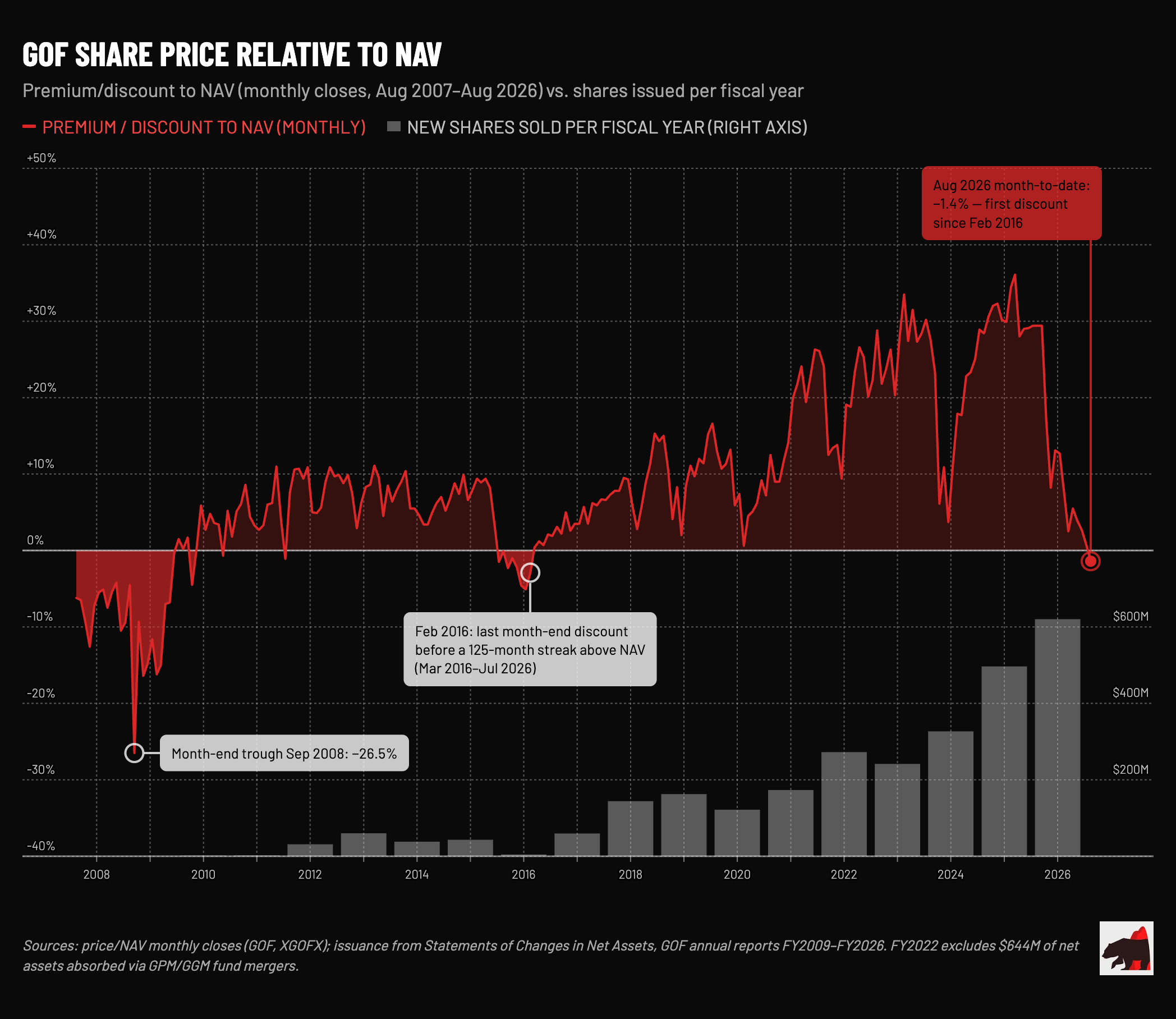
That doesn’t just make the old funding model harder. At a thin enough premium (or a negative premium!), the existing funding mechanism of an ATM (at-the-market facility) can shut off entirely.
Under the Investment Company Act of 1940, a closed-end fund like GOF generally cannot issue common shares below NAV without fitting within statutory exceptions or obtaining shareholder approval. And offering expenses — for instance, in GOF’s case, a 2% commission to the broker Cantor Fitzgerald — are deducted from the quoted price when determining if the fund is selling new shares below NAV.
Which leaves Guggenheim’s fund with a question it has rarely had to answer during the premium era: What happens to a distribution that the portfolio has not earned when new share issuance is largely restricted by statute?
That is the question we set out to answer today for paid readers of The Bear Cave.
Disclosure: The Bear Cave is now owned by Hunterbrook Media. Hunterbrook Media’s investment affiliate, Hunterbrook Capital, does not have any positions related in GOF at the time of publication. Positions may change at any time. Please see full disclosures here.